Biomaterials: "The Intersection Of Biology And Material Science" Free Pdf Download UPDATED
Biomaterials: "The Intersection Of Biology And Material Science" Free Pdf Download

1940s flexural exam machinery working on a sample of concrete
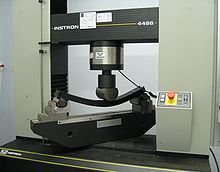
Test fixture on universal testing machine for three-bespeak flex examination
The three-point angle flexural test provides values for the modulus of elasticity in bending , flexural stress , flexural strain and the flexural stress–strain response of the material. This test is performed on a universal testing motorcar (tensile testing motorcar or tensile tester) with a three-bespeak or iv-point bend fixture. The main reward of a three-point flexural test is the ease of the specimen training and testing. However, this method has also some disadvantages: the results of the testing method are sensitive to specimen and loading geometry and strain rate.


Testing method [edit]
The test method for conducting the test usually involves a specified test fixture on a universal testing car. Details of the test preparation, conditioning, and bear touch the exam results. The sample is placed on two supporting pins a prepare distance autonomously.
Calculation of the flexural stress
- for a rectangular cross section

- for a round cantankerous department[1]

Calculation of the flexural strain

Calculation of flexural modulus [two]

in these formulas the following parameters are used:
- = Stress in outer fibers at midpoint, (MPa)
- = Strain in the outer surface, (mm/mm)
- = flexural Modulus of elasticity,(MPa)
- = load at a given point on the load deflection bend, (N)
- = Back up bridge, (mm)
- = Width of test beam, (mm)
- = Depth or thickness of tested beam, (mm)
- = maximum deflection of the center of the beam, (mm)
- = The gradient (i.e., slope) of the initial straight-line portion of the load deflection curve, (N/mm)


- = The radius of the beam, (mm)

Fracture toughness testing [edit]

Single-edge notch-bending specimen (also called three-betoken bending specimen) for fracture toughness testing.
The fracture toughness of a specimen can as well be determined using a three-point flexural test. The stress intensity factor at the scissure tip of a single border notch bending specimen is[3]
![{\begin{aligned}K_{{{\rm {I}}}}&={\frac {4P}{B}}{\sqrt {{\frac {\pi }{W}}}}\left[1.6\left({\frac {a}{W}}\right)^{{1/2}}-2.6\left({\frac {a}{W}}\right)^{{3/2}}+12.3\left({\frac {a}{W}}\right)^{{5/2}}\right.\\&\qquad \left.-21.2\left({\frac {a}{W}}\right)^{{7/2}}+21.8\left({\frac {a}{W}}\right)^{{9/2}}\right]\end{aligned}}](https://wikimedia.org/api/rest_v1/media/math/render/svg/466d7f6e915a160e93963497a9016099b626cae6)
where is the applied load, is the thickness of the specimen, is the crack length, and is the width of the specimen. In a three-point bend test, a fatigue crack is created at the tip of the notch by cyclic loading. The length of the cleft is measured. The specimen is and then loaded monotonically. A plot of the load versus the crack opening displacement is used to decide the load at which the scissure starts growing. This load is substituted into the in a higher place formula to observe the fracture toughness .


The ASTM D5045-xiv [four] and E1290-08 [five] Standards suggests the relation
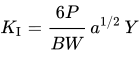
where

The predicted values of are nigh identical for the ASTM and Bower equations for crack lengths less than 0.6 .

Standards [edit]
- ISO 12135: Metallic materials. Unified method for the determination of quasi-static fracture toughness.
- ISO 12737: Metallic materials. Determination of aeroplane-strain fracture toughness.
- ISO 178: Plastics—Determination of flexural properties.
- ASTM D790: Standard examination methods for flexural backdrop of unreinforced and reinforced plastics and electrical insulating materials.
- ASTM E1290: Standard Test Method for Crack-Tip Opening Deportation (CTOD) Fracture Toughness Measurement.
- ASTM D7264: Standard Test Method for Flexural Properties of Polymer Matrix Composite Materials.
- ASTM D5045: Standard Exam Methods for Plane-Strain Fracture Toughness and Strain Energy Release Rate of Plastic Materials.
Come across besides [edit]
- Angle
- Euler–Bernoulli beam theory
- Flexural forcefulness
- Four-point flexural test
- List of 2nd moments of surface area
- Second moment of area – Mathematical construct in engineering science
References [edit]
- ^ "Affiliate 4 Mechanical Properties of Biomaterials". Biomaterials – The intersection of Biology and Textile Science. New Jersey, U.s.a.: Pearson Prentice Hall. 2008. p. 152.
- ^ Zweben, C., W. S. Smith, and Thou. W. Wardle (1979), "Examination methods for fiber tensile strength, blended flexural modulus, and properties of fabric-reinforced laminates", Composite Materials: Testing and Blueprint (Fifth Conference), ASTM International
{{citation}}: CS1 maint: multiple names: authors list (link) - ^ Bower, A. F. (2009). Applied mechanics of solids. CRC Press.
- ^ ASTM D5045-14: Standard Test Methods for Plane-Strain Fracture Toughness and Strain Free energy Release Charge per unit of Plastic Materials, West Conshohocken, PA: ASTM International, 2014
- ^ E1290: Standard Exam Method for Cleft-Tip Opening Displacement (CTOD) Fracture Toughness Measurement, West Conshohocken, PA: ASTM International, 2008
DOWNLOAD HERE
Posted by: kaycaust1949.blogspot.com

Post a Comment for "Biomaterials: "The Intersection Of Biology And Material Science" Free Pdf Download UPDATED"